Nikola Tesla: One of the geniuses behind electricity
Discover the story of scientist Nikola Tesla, inventor of the AC motor and fascinated by the number 3.
Advertisements
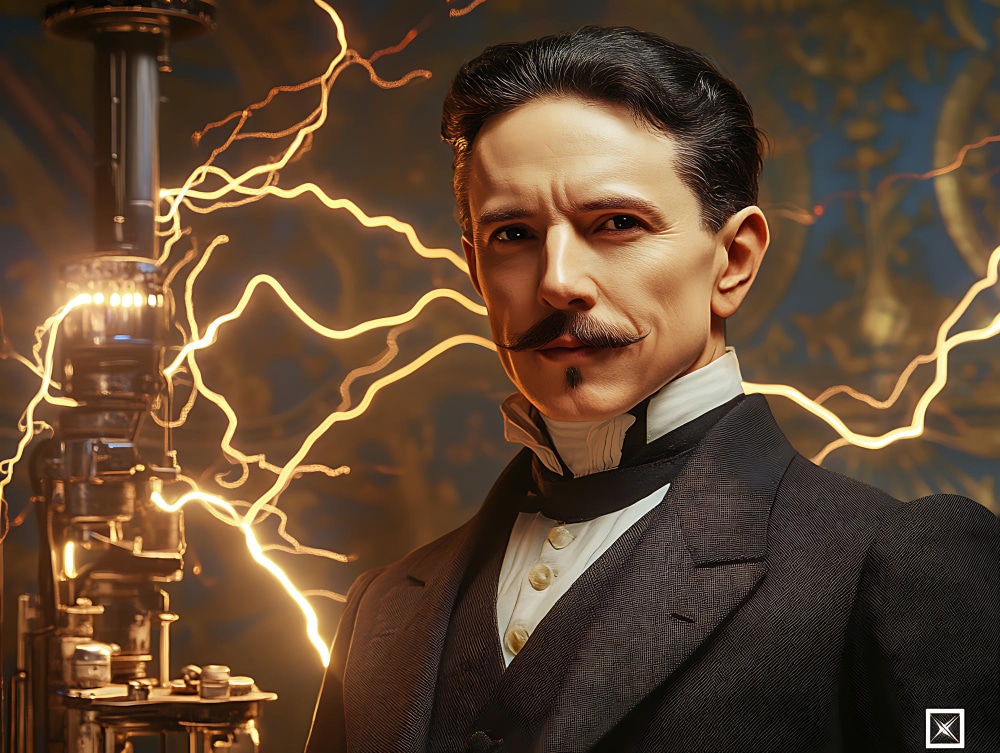
If you use electricity today, you have Nikola Tesla to thank for his contributions. History is full of people whose existence we often overlook, but who were essential to achieving the technological advancements we have today.
Tesla is undoubtedly one of these characters. He was a scientist from the Serbian-Croatian region who made many advances in the field of electricity. So, keep reading this content to learn more about the life of this man, who was fascinated by the numbers 3, 6 and 9.
Who was Nikola Tesla?
Born on July 10, 1856, in the city of Smiljan, in the former Austrian Empire, Nikola Tesla is among the most brilliant scientists in history. However, as with some of his colleagues, his true recognition came after his existence.
Although he was born in Croatia, Tesla and his family were of Serbian origin. His father, Milutin Tesla, was an Orthodox priest, and his mother was called Duka Mandić. He also had four brothers.
Tesla began his studies at schools in Smiljan and Gospić. He began his secondary education in Karlovac in 1870. It was at this time that the young man began to take an interest in electricity, and decided to study engineering.
Tesla began his engineering studies in 1875 at the Austrian Polytechnic Institute in Graz, but three years later he decided to drop out without graduating. This decision ended up damaging his relationship with his family.
Tesla's career
Since leaving college, he worked in several places in the electronics field, reaching leadership positions, including alongside Thomas Edison, with whom he later had disagreements.
In 1885, he stopped providing services to other companies and founded his own business, Tesla Electric Light & Manufacturing, which went bankrupt the following year.
Already in 1887, the scientist made his first great invention: a electric motor which operated by electromagnetic induction. In 1888, he sold it to George Westinghouse, owner of the Westinghouse Electric & Manufacturing Company.
During his career, Tesla received several titles and awards. In 1912, Tesla refused the Nobel Prize in Physics, which would have been shared with Thomas Edison.
Another interesting fact about this brilliant mind is that it is believed that he suffered from obsessive-compulsive disorder. This is because he had some manias, such as an extreme fear of dirt and germs (mysophobia) and the refusal to stay in hotel rooms whose number was not divisible by three. Tesla died in 1943, at the age of 86, in New York.
The conflict with Thomas Edison
Its most significant development was alternating current (AC), which made up the AC motor, a time-varying electric current capable of being transmitted over great distances.
In contrast, his contemporary, thomas edison, argued that the most effective way of transmitting energy was through direct currents (DC), which do not vary over time and which were very difficult to transmit over long distances.
Due to this disagreement, the two scientists fought for years. However, despite being more dangerous, Tesla's application proved to be much more efficient and is still used in energy emissions between generating plants and homes and industries.
Tesla's contributions
The scientist was responsible for inventing and contributing to many of the electricity technologies we use today.
As we have seen, the AC motor, made with the alternating current (AC) was one of its great milestones. Its main benefits were the elimination of the need for a switch, less maintenance and automatic start.
In addition to this, another of his creations that became well-known, for example, was the Tesla coil. It was created after the scientist learned about the studies of Heinrich Hertz that confirmed the presence of electromagnetic waves, in 1889, who decided to test them using coils connected to high-frequency alternating current generators.
The coils were widely used in various experiments and resulted in several technological applications, for example, in electric lighting, in the generation of X-rays, in radio transmission and telegraphy, as well as medical tools for electrotherapy and the generation of ultraviolet radiation.
During his life, Tesla also created and contributed to numerous other discoveries in his field. Here are some more of them:
- He collaborated in the creation of the radio by Marconi, which transmits information via electromagnetic waves;
- He conceived the idea of radar;
- He carried out pioneering studies on magnetic resonance imaging;
- Designed the fluorescent lamp;
- He invented the remote control device;
- Developed ignition systems for automobiles.
Number theory 3, 6 and 9
Tesla was fascinated by the numbers 3, 6, and 9. He developed a spiral that exalted the power of 3, linking it to 12 months of a year and 24 hours of a day. According to him, if you understood the greatness of the numbers 3, 6, and 9, you would have in your hands the key to the Universe.
The number 3 and its multiples were part of his daily life. He argued that the trio “energy, frequency and vibration” was the solution to understanding the universe, just as triangles are essential to mathematics and the Holy Trinity to Christianity.
His obsession led him to peculiar habits, such as: walking around the block three times before arriving home, using exactly 18 napkins to clean his dishes, and always choosing hotel rooms with numbers that were multiples of 3. Ironically, he died in apartment 3327.
Finally, without a doubt, Nikola Tesla was an important figure for science and his creations continue to make our lives easier to this day. And if you like this type of content, then be sure to check out other brilliant minds that changed history.