Sahara Desert: a tour of the largest hot desert on the planet
Fascinating stories and natural beauty that few places in the world can offer.
Advertisements
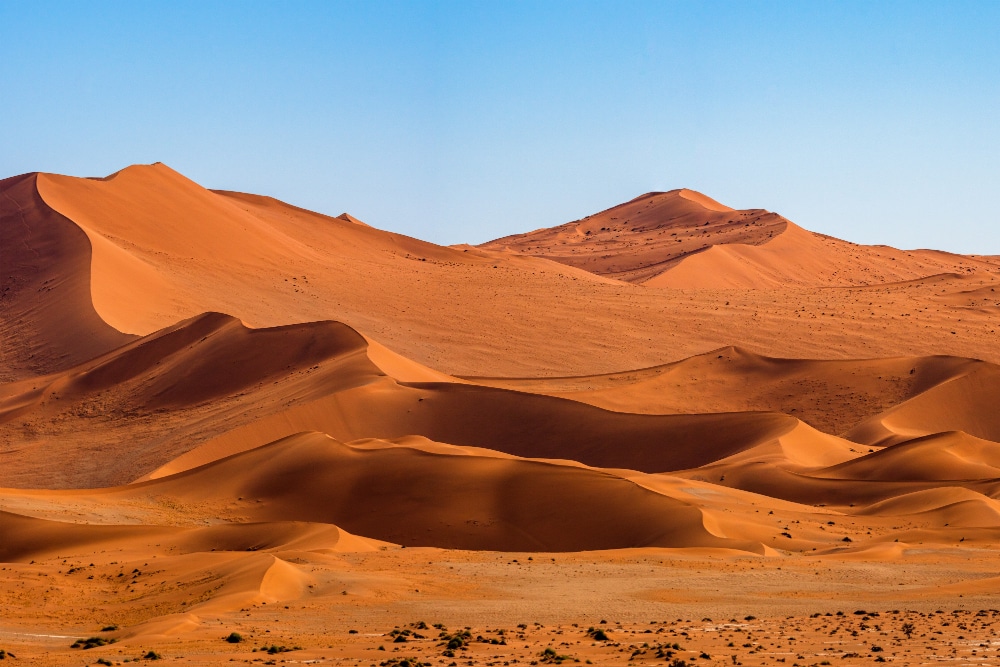
Imagine a place where silence is as vast as the landscape around you. That place is the Sahara Desert, one of the most impressive and mysterious landscapes in the world, with seemingly endless dunes and a climate that challenges even the bravest.
Want more? The Sahara Desert is also a great place for adventure lovers, with camel trails, nights under a breathtaking starry sky and the chance to connect with nature in a unique way. Check it out and be amazed!
Geography and location
As we have already mentioned, the Sahara Desert is the largest hot desert in the world, covering an area of more than 9 million km². It also extends across 11 countries in North Africa. This vast expanse of sand and rocks certainly creates unique landscapes, from dunes to plains and mountains.
In fact, the Sahara is not just a sea of sand: it is also home to mountain ranges such as the Atlas and the Tibesti, as well as depressions that are even below sea level. The climate is extreme, with scorching days and freezing nights, but this variation is part of the charm of this incredible place.
And don't think that the Sahara is all desolation: the desert also has dry rivers, called wadis, that come to life during rare rains, and oases that serve as refuges for human and animal life. It is certainly a place full of contrasts and surprises.
Life in the Sahara Desert
Despite the arid climate and extreme conditions, several species of plants and animals have found ways to survive. For example, plants such as date palms and acacias have deep roots to seek water. While the fennec fox, desert fox, has evolved large ears to dissipate heat.
Furthermore, oases are vital points for human and animal life. They provide water, shade and even areas for cultivation, sustaining communities that have lived in the Sahara for centuries. These places are certainly true refuges in the midst of so much aridity.
And we cannot forget the Bedouin people, who have mastered the art of living in the desert. With their ancestral knowledge, they know where to find water, how to protect themselves from the heat and how to move through the dunes. Life in the Sahara is a lesson in resilience and connection with nature.
A little bit of culture and history
For thousands of years, the Sahara Desert was the site of trade routes connecting sub-Saharan Africa to the Mediterranean, carrying gold, salt and spices. Ancient cities such as Timbuktu emerged as centers of commerce and culture, leaving an impressive legacy.
The Bedouin people, desert nomads, have a rich culture full of wisdom. They live in harmony with the environment, following traditions passed down from generation to generation, such as the art of navigation by the stars and hospitality, which is one of the pillars of their society.
In fact, cave paintings found in places like Tassili n'Ajjer show how the Sahara was once a green and vibrant region. These records certainly tell stories of ancient civilizations and climate change that shaped the desert we know today.
Examples of tourism and adventure
The Sahara Desert is a paradise for those seeking adventure and unique experiences. One of the most popular activities is camel riding, where you can explore the dunes at the slow, relaxing pace of these animals.
For the more adventurous, 4×4 safaris are a great option, taking you through stunning landscapes and exciting challenges. What’s more, camping under the stars in the Sahara is an unforgettable experience. Imagine sleeping in Bedouin tents, with the brightest starry sky you’ve ever seen, while listening to stories around a campfire. It’s undoubtedly a unique connection with nature and local culture.
And if you like history, be sure to visit ancient cities such as Merzouga or Zagora, which offer a mix of culture, tradition and incredible landscapes. Therefore, the Sahara is a destination that combines adventure, relaxation and learning.
Environmental impact and conservation of the Sahara Desert
The Sahara Desert faces serious environmental challenges, such as desertification, which is advancing due to the increasingly dry climate and inappropriate land use. This affects not only biodiversity, but also local communities, who depend on the land for their survival.
In fact, lack of water and soil degradation make life even more difficult in desert regions. On the other hand, there are conservation initiatives that seek to combat these problems.
In this sense, reforestation and sustainable management projects of natural resources are gaining momentum, helping to preserve oases and remaining green areas. In addition, local and international organizations are working to raise awareness about the importance of protecting this unique ecosystem.
And there’s more: the Sahara is also suffering from the impact of global climate change, which alters rainfall and temperature patterns. Despite the challenges, the fight to conserve the desert and its biodiversity continues, showing that there is still hope for this incredible place.
Importance of this region for the world
It may not seem like it, but the Sahara Desert plays an important role in the balance of the planet. This is because influences global weather patterns, such as monsoons in Africa and even the climate in the Amazon, thanks to sandstorms that carry essential nutrients to distant forests.
Without it, the climate in many regions of the world could be very different. In addition, the Sahara is home to unique biodiversity, with plant and animal species adapted to extreme conditions.
It is also worth mentioning the living beings of desert regions, which are fundamental for scientific studies, helping to understand how life adapts to hostile environments. Therefore, their preservation is essential to keep this ecosystem functioning.
And we cannot forget the cultural and historical role of the desert. After all, it preserves ancient traditions and trade routes that shaped civilizations. Therefore, protecting the Sahara also means preserving part of human history.
That's it! The Sahara Desert is a place of contrasts and unique beauty, which teaches us about resilience and the importance of preserving our planet. Since you've come this far, check out some interesting facts about the Sahara Desert. Byzantine Empire. To the next!