
The world of Byzantium: find out about 5 interesting facts about the Byzantine Empire
Hagia Sophia, the genius of Greek Fire and the glorious capital are part of the history of one of the most influential empires in the world.
Advertisements
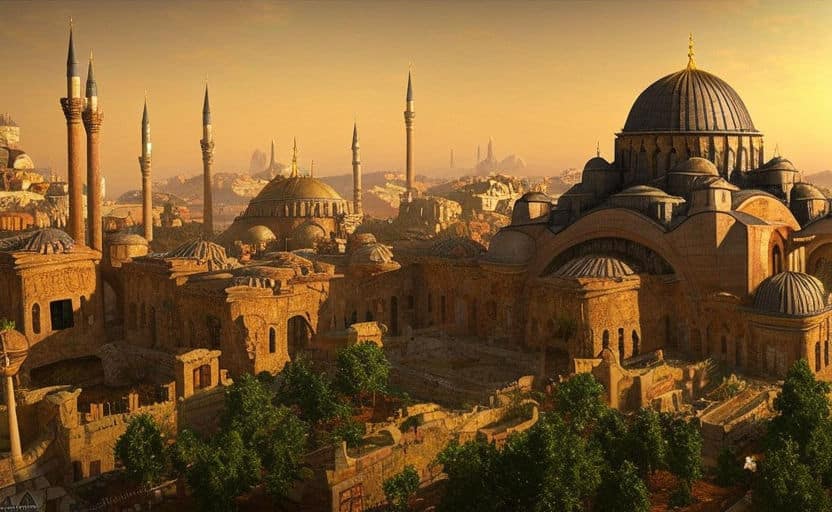
The Byzantine Empire was the eastern half of the Roman Empire that prospered for over 1000 years after the fall of the West in 476 AD. With a rich Greco-Roman culture, the empire was characterized by numerous achievements responsible for European development.
A cultural, economic and military powerhouse in the Mediterranean, the Byzantine Empire was a major influence on the medieval world. Today, we’ll delve into its rich history to discover 5 fascinating facts that set it apart as a powerful and unprecedented civilization. Check it out now!
1. Heirs of Rome
Founded in 395 AD, the Byzantine Empire was not merely an eastern extension of the Roman Empire, but rather a direct continuation of its grandeur and heritage. For example, the Byzantine Empire modeled itself on Roman government, with an emperor as supreme leader, and retained the intricate Roman administrative organization, which included the Senate and bureaucracy.
Roman law was also maintained and organized in the Code of Justinian, playing a fundamental role in the legal system of the Byzantine Empire. In addition, Christianity, which became the official religion of the Roman Empire in the 4th century, also prevailed as the predominant faith in the Byzantine Empire, although it adopted the orthodox form.
2. glorious capital
The city of Constantinople, capital of the Byzantine Empire, was more than just a city. It was an icon of influence, prosperity and scholarship, recognized as the 'City of Cities' and revered as the epicenter of the empire.
Located at the confluence of the Aegean Sea and the Black Sea, Constantinople exercised dominance over the main trade routes between the East and the West, promoting considerable prosperity for the empire.
Furthermore, Constantinople stood out as an imposing metropolis, full of luxurious palaces, magnificent churches and impressive monuments, such as the Hagia Sophia, which left visitors from all over the world in awe.
Incidentally, Hagia Sophia is famous for its architecture, especially its enormous central dome, which was one of the largest in the world for centuries. During the Byzantine period, the city's decoration featured mosaics and religious works of art. But after the fall of Constantinople to the Ottoman Empire in 1453, Hagia Sophia was converted into a mosque.
3. Greek fire
Greek fire was a powerful incendiary weapon that played a crucial role in the defense of the Byzantine Empire for centuries. Its use was of great importance in defending against seaborne invasions, especially against Arab and Muslim attacks.
Although the precise formulation of Greek fire remains a mystery, it is widely accepted that its composition involved elements such as naphtha, saltpeter, sulfur, and quicklime.
It was characterized by its extremely high flammability and its ability to adhere to water, which made it notoriously difficult to extinguish and very powerful. In addition, Greek fire had the ability to be fired in the form of projectiles or through tubes, resulting in the incineration of enemy vessels and generating intense fear and devastation.
4. Praetorian Guard
The Praetorian Guard consisted of highly trained and loyal soldiers drawn from the Byzantine army. Renowned for their strict discipline and extreme loyalty to the emperor, they were a powerful force and were respected by all who challenged imperial authority.
In addition to its main function of protecting the emperor, the Praetorian Guard had a number of important responsibilities, which included ensuring public order both in Constantinople and in strategic areas of the empire.
It also wielded considerable political influence. The loyalty of members of the guard often influenced the political decisions of the empire, and ambitious leaders sought to win the support of the Emperor to ensure their succession to the throne.
5. Art and architecture
The Byzantines were masters of mosaics, icons and architecture, with unique characteristics that influenced the development of medieval art.
Thus, the mosaics in Hagia Sophia, Chora Monastery, and St. Mark's Basilica in Venice represent Byzantine mosaic art. The renowned icon of the Virgin Mary with the Child Jesus, called the “Theotokos”, is one of the most recognized Byzantine icons.
In addition to Hagia Sophia, the Church of Saint Irene in Istanbul and the Basilica of Saint Vitale are important examples of Byzantine architecture, recognized throughout the world.
Such was the legacy that to this day museums such as the Byzantine and Christian Museum in Athens, the Byzantine Museum in Thessaloniki and the Dumbarton Oaks Research Library and Collection in Washington, DC, preserve and exhibit works of Byzantine art.
There you go! Did you like this content? So, how about sharing it with your friends on social media and staying up to date with more interesting facts like this? By the way, Discover the 5 shipwrecks that stopped the world. Until later!