Malcolm X: A Legacy That Continues to Inspire Struggles for Justice and Equality
By understanding his trajectory, we can see the importance of questioning and challenging the oppressive system.
Advertisements
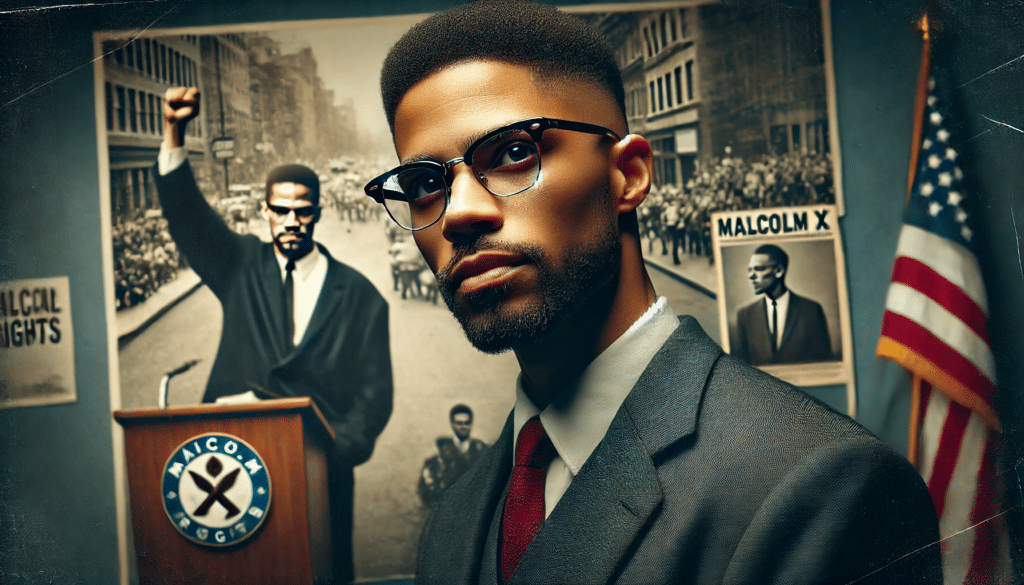
Malcolm X was one of the greatest leaders of the civil rights movement in the United States and his influence extends far beyond his time. His fight for equality and justice, often in conflict with established standards, still resonates in the modern world.
Throughout his life, Malcolm X underwent profound transformations that shaped his vision of freedom and human rights. This evolution is key to understanding the lasting impact of his message, which, even decades later, continues to inspire social movements.
Malcolm X's childhood and youth
Malcolm X's childhood was marked by a series of losses and violent events that shaped his way of seeing the world. As a young boy, he saw his house burned down by white supremacists and, shortly after, his father was killed under suspicious circumstances.
His mother, psychologically shaken and without support, ended up hospitalized, and his brothers were separated into different shelters and foster homes. Thus, he grew up in an environment dominated by institutional racism, where teachers discouraged any big dreams coming from a black boy.
Even though he was one of the best in his class, he heard that being a lawyer was not for someone like him. This not only hurt his self-esteem but also sowed a revolt that grew with him.
Malcolm X's youth was turbulent, especially after he moved to Boston. There, he immersed himself in a fast-paced urban lifestyle, involved in drugs, gambling and petty crime. This turbulent period also contributed to the formation of his critical view of inequality.
The prison and the spiritual turnaround
When Malcolm X was arrested in 1946 for robbery, he was already immersed in a lifestyle full of excesses and prison did not seem, at first, to be something transformative. However, it was precisely there that he came into contact with books that changed everything.
In prison, he read philosophy, history and, most importantly, authors who spoke about racism and racial consciousness. During this period, he learned about the Nation of Islam through letters sent by family members, especially his brother Reginald.
From there, he immersed himself in the teachings of Elijah Muhammad, the leader of the movement, and began to question every detail of the system that had oppressed him since childhood. Soon, this process ignited an intense desire for change.
When Malcolm was released from prison in 1952, he was no longer the same. With a clear vision of structural racism and the need for black empowerment, he decided to dedicate himself fully to the fight for justice. Prison, which had previously seemed like the end of the line, became the point where everything began again.
The connection with the Nation of Islam
After years of personal and social conflict, Malcolm X found a new direction by reaching out to the Nation of Islam. This contact began while still in prison, when he received letters from his brother Reginald telling him about the teachings of Elijah Muhammad.
Of course, the idea of a strengthened black identity and free from white influence immediately caught his attention. So he immersed himself in his studies, read about African-American history and began to see Islam as a tool for reconstruction.
After all, the Nation of Islam offered more than religion; it brought discipline, self-esteem and, most importantly, a direct response to oppression. Malcolm saw himself there, in that firm and direct speech that did not accept submission.
After his release, he became one of the movement's main spokespeople. He organized temples, traveled around the United States, and took the message to thousands of people. In fact, the power of his words came from real life experience and a sense of urgency.
The fight for civil rights and social justice
Malcolm X did not follow the path of diplomacy. While many believed in integration, he spoke of separation and self-defense, without fear of confrontation. His fight for civil rights was direct, pointing the finger at institutional racism and denouncing violence against black people clearly, without embellishment.
In fact, he used every speech as a weapon, especially when he exposed the hypocrisy of the US government that preached freedom, but kept millions in inhumane conditions. Malcolm demanded immediate justice, not promises for the future.
Even without holding political office, he had an influence like few others. In this way, he organized communities, strengthened the self-esteem of black people and challenged a system that tried to silence any voice that was uncomfortable.
Malcolm X and his relationship with Martin Luther King Jr.
Malcolm X and Martin Luther King Jr. represented two very different paths within the same struggle. While King advocated peaceful resistance and silent marches, Malcolm X spoke of self-defense and direct action. This generated conflict, of course, but it also made clear the extent and complexity of the oppression they faced.
They lived in similar contexts, but responded in opposite ways. On the one hand, Malcolm denounced the slowness of changes and accused pacifism of fostering submission. For him, accepting aggression without reaction made no sense in the face of the daily suffering experienced by black people.
His criticism of King, however, was not personal, but rather a warning against the illusion that the oppressor would yield only if he were willing. Even so, the two men respected each other. In 1964, they even met briefly at the Capitol. It was brief, but symbolic.
Over time, Malcolm came to recognize that the methods might be different, but the goal was the same: freedom. This realization came even stronger after he left the Nation of Islam and began to see new possibilities for unity.
Evolution after the pilgrimage to Mecca
The pilgrimage to Mecca in 1964 turned everything upside down in Malcolm X's mind. There, he found Muslims of various ethnicities living together without racial division, something that contradicted what he had learned in the Nation of Islam. Seeing whites and blacks praying side by side made him begin to reconsider many of his ideas.
In fact, this trip opened space for a new thought: he began to defend unity among oppressed peoples of different colors, as long as they were willing to fight for real justice. Thus, the change did not erase their firmness, but broadened their outlook.
Now Malcolm was talking about human rights, not just civil rights. This struck a chord with his base and with his former allies. Upon his return, he founded the Organization of Afro-American Unity, which focused on raising political consciousness and denouncing racism on a global scale.
Thus, he no longer spoke only to black people in the United States, but also to Africans, Latin Americans and any people facing systematic oppression. His struggle gained new momentum, even as the risk increased with each speech.
Legacy in the black movement
Malcolm X's legacy continues to pulsate in every movement that defends the identity and autonomy of the black population. After all, he did not ask permission to take a position, nor did he soften his tone to please. On the contrary, he shed light on issues that many avoided, such as structural racism, social control and police violence.
After his death, the impact of his ideas grew even more. He inspired from the Black Panthers to artists like Public Enemy, writers and activists from all over the world. It wasn't just about fighting, it was about understanding who you are, where you come from and why this bothers the system so much.
Today, anti-racist groups use his words as a guide to resist. The phrase "for whatever it takes" still echoes when black people need to assert themselves in spaces that try to erase them. Malcolm did not become a symbol by chance, he became one because he lived exactly what he said, without filter and without retreat.
The Death of Malcolm X
Malcolm X was killed on February 21, 1965, at the Audubon Ballroom in New York City. He was speaking to the Organization of Afro-American Unity when three gunmen appeared and opened fire. The attack was quick and calculated, and the crowd included his wife and young daughters.
Days earlier, he had been receiving constant threats. His departure from the Nation of Islam, along with his public criticism of the group’s leadership, increased the tension. He certainly knew the risk, but he continued speaking out anyway, always with courage.
For a long time, the case was full of loose ends. In 2021, two men convicted of the murder were acquitted after years of investigation. This exposed serious flaws in the process and raised new questions about the actions of the FBI and the New York police.
Even after decades, Malcolm X's death still carries a weight of silence and manipulation that the system itself has never properly explained.
That's it! Because of all this, Malcolm X didn't just become history, he became a reference. To this day, his ideas provoke, disturb and make us think. Since you've come this far, get to know the story of Frida Kahlo: a Latin artist who immortalized her pain. Until next time!