Wheel of Sansara: The Cycle That Connects Birth, Life, and Rebirth
The real way out is not an external escape, but an internal transformation.
Advertisements
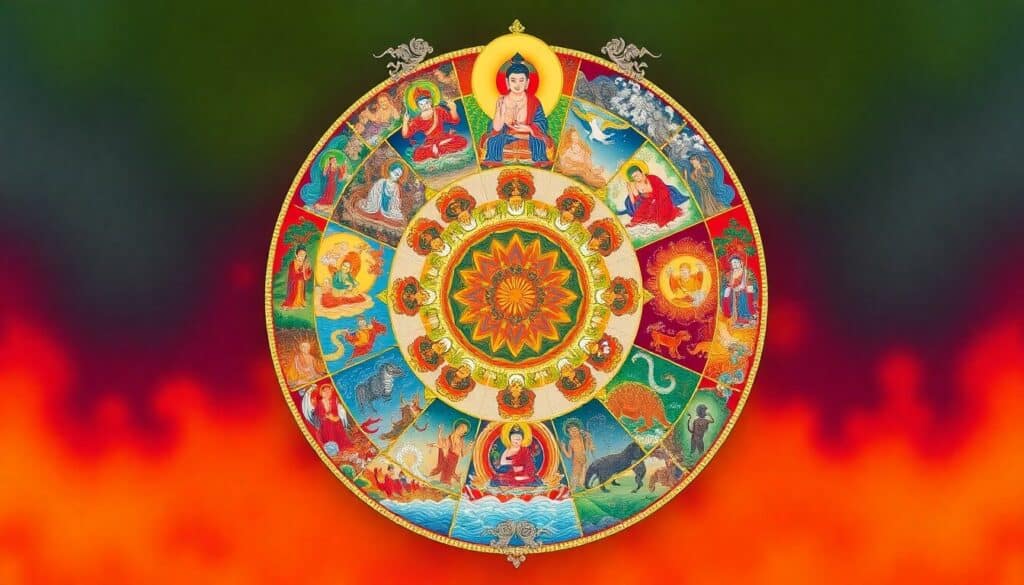
The wheel of Sansara depicts much more than a simple cycle of birth and death. It represents the repetition of human experiences, where desires, choices, and consequences intertwine. When you consider this concept, you realize that life is not linear, but rather a constant flow of ebbs and flows.
By understanding the wheel of Sansara, you begin to reflect on how your actions shape each stage of this journey. After all, if everything repeats itself, it makes sense to seek awareness in the present to transform the future. And it is precisely at this point that philosophy comes to life, offering lessons that directly impact our daily lives.
What is the Wheel of Sansara?
Have you ever stopped to think about the endless cycle of life, death, and rebirth? This is the essence of the wheel of Sansara, a central concept in many spiritual traditions, especially Buddhism and Hinduism.
Think of it as a grand cosmic cycle keeping us trapped in a continuous flow of experiences. It's not just about birth and death, but about the consequences of our actions, which determine where and how we will be reborn. A cycle that, for many, is marked by suffering, but which also offers a path to liberation.
Indeed, the crucial point is that this cycle is intrinsically linked to suffering. No matter what sphere you are reborn into, there will always be some kind of dissatisfaction. Whether it's the relentless pursuit of pleasures that never fully satisfy, the pain of loss, the fear of death, or ignorance of the true nature of reality.
Thus, the wheel of Sansara shows us that as long as we're trapped in this cycle, we're subject to these experiences. In other words, it's like being on a treadmill: you can run faster or slower, but you'll stay in the same place unless you know how to get off it.
The six realms of existence
In fact, the wheel of Sansara is not a single place, but a model that describes different realms or planes of existence where a being can be reborn. They are generally divided into six spheres, each with its own characteristics and types of suffering.
1. Kingdom of the Gods
The realm of the gods, known as Devas, appears within the wheel of Sansara as a space of abundance and pleasure. In it, beings enjoy long lives, surrounded by comfort and beauty, but they do not find liberation, as they still remain trapped in the cycle of rebirth.
Even with so much happiness, the Devas remain subject to impermanence, and when their positive energy runs out, they must be reborn in other realms. This detail shows how even a state filled with joy can hide pitfalls, as the pursuit of satisfaction keeps attachment alive.
The realm of the gods practically symbolizes a mental state linked to euphoria and excessive pleasure. While it seems ideal, it limits spiritual awakening because it deludes the sense of completeness.
2. Realm of the Demigods
The realm of the demigods, called Asuras, appears in the wheel of Sansara as a space dominated by envy and the desire for power. These beings live in constant conflict with the gods, as they observe the happiness of the Devas and feel frustrated at not achieving the same level of pleasure.
Thus, this energy of rivalry causes the Asuras to cultivate endless wars, always driven by pride and anger. Despite having strength and resources, they find no peace, as constant comparison further fuels dissatisfaction.
In practice, the realm of the demigods symbolizes mental states linked to excessive competition and the feeling of never being satisfied. Therefore, this cycle shows how the obsession with power ultimately reinforces suffering within the wheel of Sansara.
3. Human Kingdom
The human realm, called Manushyaloka, occupies a special place within the wheel of Sansara, as it offers a balance between pleasure and pain. Unlike gods and demigods, humans live within clear boundaries, but they also carry the possibility of seeking spiritual awakening.
In this kingdom, life mixes fleeting joys and inevitable sufferings, which generates awareness of impermanence. This perception opens space for reflection, discipline, and spiritual practice—conditions that don't appear with the same intensity in other realms.
Therefore, the human state symbolizes the opportunity for transformation. Between mistakes, lessons learned, and daily choices, the opportunity arises to break the cycle of rebirth and walk toward liberation within the wheel of Sansara itself.
4. Kingdom of Animals
The kingdom of animals, called Tiryag-yoni, is part of the wheel of Sansara and symbolizes lives guided by instinct and the need for survival. In this space, beings live in constant search for food and safety, often trapped in fear and submission before greater forces.
Thus, this condition represents limitations of consciousness, as the focus remains solely on basic needs. Thus, there is no room for deep reflection or spiritual advancement, which keeps the cycle of rebirth active.
Symbolically, the animal kingdom also demonstrates mental states in which people act automatically, without clarity. When instinct overrides reason, learning is blocked and suffering continues.
5. Kingdom of Hungry Ghosts
The realm of hungry ghosts, called Preta-loka, appears in the wheel of Sansara as a place of insatiable desire. That is, the Pretas live in constant hunger and thirst, but their narrow throats and enormous stomachs prevent them from finding satisfaction, creating endless suffering.
This state reflects not only mythological beings, but also the human mind when it plunges into greedAfter all, the compulsive search for consumption, status or pleasure never fills the inner void and, on the contrary, further increases the feeling of lack.
Thus, the realm of hungry ghosts shows how extreme attachment imprisons. When desire dominates without limits, life becomes an exhausting race that reinforces the cycle of the wheel of Sansara.
6. Kingdom of Hell
The hell realm, called Naraka, appears in the wheel of Sansara as a space of intense and continuous suffering. In this place, beings endure extreme pain ranging from scorching heat to freezing cold, with no respite or relief.
Each torment reflects mental states dominated by hatred, anger and resentment. Thus, Naraka symbolizes the direct consequence of violent or malicious actions, showing how negative choices fuel cycles of pain.
In practical terms, this realm also relates to moments in life when resentment and aggression take over the mind. When these feelings are not addressed, the experience repeats itself, keeping the wheel of Sansara active.
The Three Poisons That Feed Sansara
Ignorance, or Avidya, is not simply not knowing something. It is a fundamental blindness to the true nature of reality. That is, it is failing to perceive the impermanence of everything, the interconnectedness between beings, and the absence of a fixed and separate 'self.'
In other words: it's like trying to navigate a dark room, tripping over furniture we don't even know is there. This lack of clarity leads us to act incorrectly, creating more suffering for ourselves and others. In fact, it's the root from which the other two poisons spring.
The second poison is attachment, or Raga. Here, it is the intense desire for what pleases us, the craving for pleasurable experiences, possessions, people, or even ideas. In other words, it's the incessant search for more, the difficulty in letting go of what brings us comfort, even if temporary.
Imagine a person clinging to a dry branch that's about to break: clinging to this illusory security will only lead to their downfall. Thus, this constant desire creates a dependency, an anxiety that prevents us from finding contentment in the present and forces us to relentlessly seek the next satisfaction.
On the other hand, we have aversion, or Dvesha, which is the repulsion, hatred, anger and rejection of that which displeases usIt's the tendency to push away, to fight against what causes us discomfort, pain, or fear. Think of someone who shuts down completely when hearing an opinion different from their own or who rebels against life's difficulties.
This resistance creates a barrier, a wall that isolates us and prevents us from learning from experiences, even difficult ones. In this way, aversion consumes us, generating more suffering and distancing us from a more balanced and compassionate view of life.
How to get out of the wheel of Sansara?
Buddhism presents the Noble Eightfold Path as the route to liberation. Indeed, it is not a set of rigid rules, but eight interconnected aspects that, when cultivated, lead to the cessation of suffering.
It begins with 'Right Understanding,' which is understanding the nature of reality, including the Four Noble Truths. Next comes 'Right Thought,' directing the mind toward kindness and nonviolence. 'Right Speech,' involves speaking the truth, kindly and helpfully.
'Right Action' refers to not harming others, acting ethically and compassionately. 'Right Livelihood' means earn an honest living, without causing harm. 'Right Effort' is the effort to cultivate positive mental states and abandon negative ones.
Right Mindfulness is the constant awareness of body, feelings, mind, and phenomena. Finally, Right Concentration is the development of a focused and serene mental state, usually through meditation.
Meditation and mindfulness are powerful tools in this process. After all, they allow us to observe our thoughts, emotions, and sensations without judgment, recognizing the patterns that keep us stuck in the Wheel of Sansara.
By practicing mindfulness, we develop the ability to see things as they truly are, without the distortions caused by our desires and aversions. Meditation, in turn, calms the mind, making it more receptive to wisdom and compassion.
There you go! The Wheel of Sansara invites us to look at existence from a broader perspective, recognizing the patterns that repeat themselves in our lives and in the world around us. Take advantage of the fact that you've come this far and learn all about the chakras: the key to personal transformation. Until next time!