
Maria Bonita: the story behind the woman who left her mark on the cangaço
She teaches us that heroism can take many forms and that true freedom is a constant struggle.
Advertisements
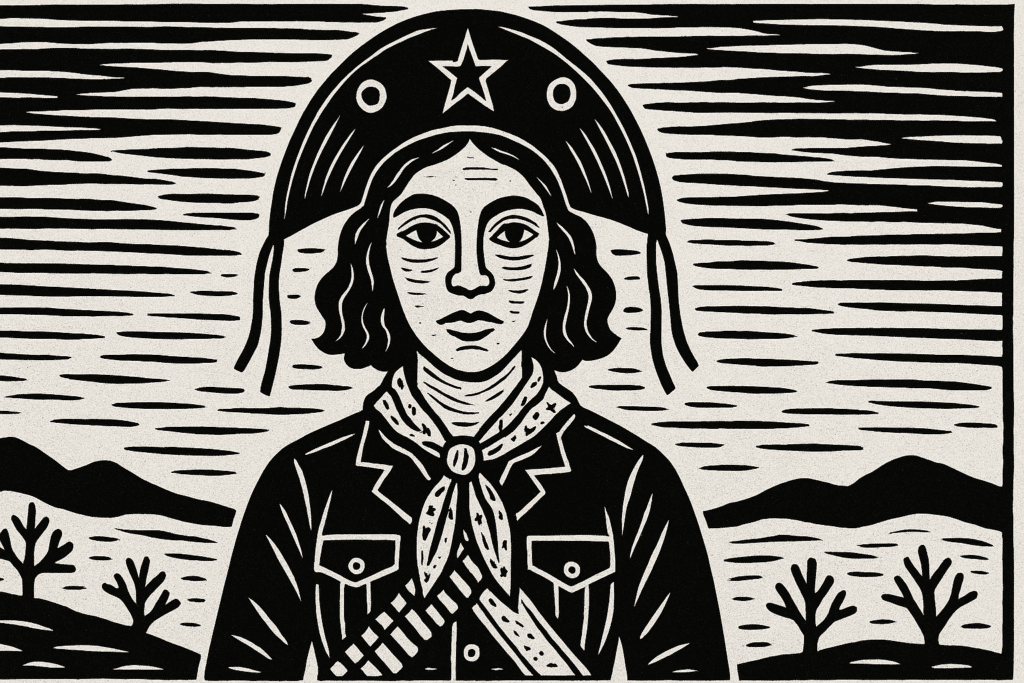
Do you know the story of Maria Bonita? If not, it's time to discover a remarkable figure from Brazil's past. Much more than just being Lampião's partner, she embodied a courageous woman who broke barriers and became an emblem of strength and struggle in the Northeast countryside.
Imagine a time when women barely had a voice or a place in society. In this scenario, a woman emerges who defies these limitations, joins the cangaço, and assumes a prominent role within this universe. This is how the remarkable story of Maria Bonita unfolds. Check it out!
Who was Maria Bonita?
Maria Gomes de Oliveira, born on March 8, 1911, in Malhada da Caiçara, Bahia, was not limited to being Lampião's partner. In fact, she stood out as a key figure in the cangaço movement, overcoming obstacles and displaying courage and determination remarkable for her time.
In fact, her trajectory leads us to reflect on the role of women in the community and the challenges faced in rural areas. For this reason, Maria Bonita is considered one of the most prominent and respected figures in the cangaço movement.
The historical context of the northeastern hinterland
Life in the sertão was marked by drought, lack of resources, and government neglect. Thus, people depended on subsistence farming, but rain was a luxury. When drought struck, there was hunger, poverty, and many people struggling to survive as best they could.
It was a complicated cycle. You either accepted that reality or tried to fight it. It was in this scenario that the cangaço movement emerged, as a reaction of resistance against this reality.
And don't think it was just poverty, no. Power also rested in the hands of a few large landowners. These few ruled rigidly, exploited workers, and used force to maintain their dominance. It was a profoundly unfair system, where those in power sought to accumulate even more wealth, while the poorest struggled to survive with the bare minimum.
Maria Bonita's relationship with Lampião
Maria Bonita's life is closely intertwined with Lampião's. Discussing one without mentioning the other is almost impossible, and their relationship is one of the most intriguing and controversial aspects of the history of cangaço. Theirs went beyond mere romance, becoming an alliance that broke new ground and left its mark on time.
Maria Bonita, exhausted from an oppressive relationship, found in Lampião not only a new love but also a new identity. Shortly thereafter, she abandoned her domestic routine to join the group, becoming the pioneering female active participant in the cangaço.
That's right. She not only accompanied Lampião on his travels through the backlands, she was also present at battles and contributed to important decisions within the gang. Certainly, the connection between them was based on trust and mutual admiration, something unusual for that time.
In fact, they lived together for about eight years, until they were brutally murdered in 1938 in the Angicos Grotto. Their story is full of passion, adventure, and tragedy, and continues to inspire and intrigue people to this day. They also had a daughter, Expedita Ferreira Nunes, born in 1932.
The image of Maria Bonita in popular culture
It is noteworthy that Maria Bonita went beyond the context of cangaço to become a symbol of popular culture in Brazil. Her name is remembered not only as that of Lampião's partner, but also as a representation of female courage and resistance in an extremely difficult social environment.
Indeed, the way Maria Bonita appears in different cultural expressions and artistic works reveals a lot about how we interpret history and the place of women. For this reason, her image takes on various forms, from an idealized heroine to a protagonist of social transformation.
Legacy and memory of Maria Bonita
Maria Bonita is remembered in very different ways. For many, she is considered a courageous woman who broke the norms of her time and accompanied Lampião into battle. Others, however, view her with more skepticism, evaluating her involvement in the cangaço and the group's attitudes. Undoubtedly, this ambiguity shapes her legacy.
In popular culture, Maria Bonita won several representations. There was a movie, a series, a book, and each one shows a different side of her. The miniseries Lampião and Maria Bonita, for example, helped popularize her image, but also generated debates about historical accuracy.
It is also worth remembering the songs and the literature of twine, which narrate her journey in a unique way. Without a doubt, Maria Bonita serves as inspiration for various cultural and artistic manifestations.
Regardless of how we view her, Maria Bonita broke new ground. After all, she challenged the role of women in the Northeastern backlands, showing that they could be strong and independent.
Today, many women consider her an icon of courage and autonomy, someone who fought to secure her place in a male-dominated environment. This aspect deserves to be highlighted. Finally, her journey leads us to reflect on the role of women in the community and the urgent need to strive for equality.
That's it! Remembering Maria Bonita's story goes beyond keeping her memory alive; it's also an opportunity to reflect on the strength and courage of women throughout history. In this context, learn about the stories of other women who transformed the course of history. See you soon!