Between life and death: explaining Schrödinger's cat paradox
Until an observer opened the box, surprisingly, the feline could be in two states – alive and dead.
Advertisements
Schrödinger's cat is a thought experiment proposed by physicist Erwin Schrödinger in 1935. The experiment aims to illustrate the Copenhagen interpretation of quantum mechanics, which states that subatomic particles can exist in more than one state simultaneously.
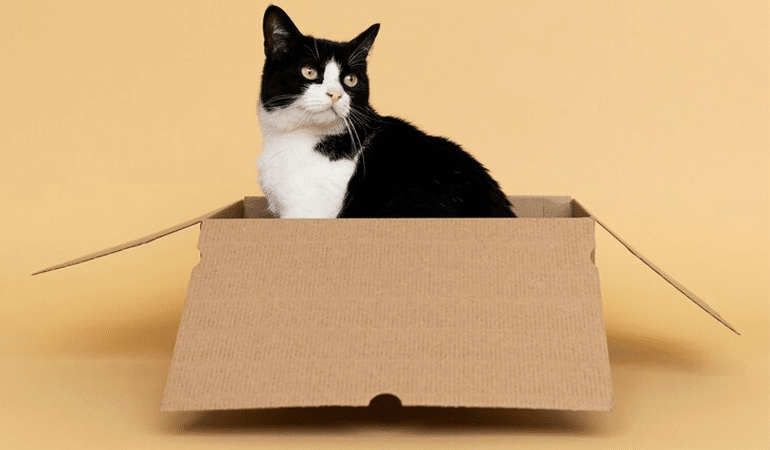
In Schrödinger's experiment, a cat is placed in a sealed box along with a vial of poison, which is connected to a radiation sensor. If the device detects radiation, it breaks the vial, releasing the poison and killing the cat.
According to the Copenhagen philosopher's interpretation, before we open the box, the cat is in superposition of states. In other words, just as he can be considered alive, he can also be considered dead.
Therefore, only when we open the box and interact with the system, the cat is forced to enter a unique state – alive or dead.
Schrödinger's cat paradox
Schrödinger's cat has become known as a paradox because it is hard to imagine how a cat could live and die simultaneously. If the cat is alive, the radiation counter should not have detected radiation. But if the radiation sensor did not detect radiation, the vial of poison did not break and the cat did not actually die.
The Copenhagen analysis of quantum mechanics states that the cat is in a superposition of states. But this interpretation is difficult for most people to accept.
Unraveling quantum superposition
In simple terms, quantum superposition is a phenomenon that occurs in the subatomic world. Thus, subatomic particles, such as electrons, protons, and neutrons, can exist in more than one state at the same time until the moment of observation.
For example, an electron can be in a superposition of states so that it is in two places simultaneously.
Understand that quantum superposition is a very counterintuitive idea. This is because it challenges our understanding of reality. Now, if subatomic particles can be in more than one state at the same time, what else could be?
The Fairy Paradox in Contrast
Of course, Schrödinger's cat paradox is the best-known example of superposition. But there are other superposition paradoxes besides this one, such as the fairy paradox, created by Australian theoretical physicist David Deutsch in 1997.
A fairy is placed in an airtight box. If the fairy is present, she will move a speck of dust. But if she is absent, the speck of dust will remain motionless.
According to the Copenhagen proposal, the fairy is present and absent before the box is opened. Consequently, before we open the box, the dust particle is in a superposition of states, and can be in motion or motionless.
Deutsch argues that this is absurd, since a dust particle cannot be in two opposite states at the same time. He claims that the Copenhagen theory must be wrong.
How can science save Schrödinger's cat?
When the particle undergoes analysis, the unpredictable and abrupt transition between these energy states is identified as a quantum leapIt is precisely this transition phenomenon that physicists have managed not only to anticipate, but also to control and alter its outcome.
The research was conducted on artificial atoms called qubits, which are also used as fundamental units of information in quantum computers. Zlatko Minev, who led the research, said the aim was to test the feasibility of receiving an early warning that a transition is about to happen soon.
The remarkable manifestation of this experiment is the intensification of coherence during the transition, even when it is observed. According to Zlatko Minev, it is possible to take advantage of this not only to identify the transition, but also to reverse it.
This is because, in reality, the research showed that the phenomenon is closer to a transition and can be manipulated, which, in the context of Schrödinger's cat, could result in its salvation.
For physicists, the reversal of one of these events implies that the evolution of the quantum state has a deterministic rather than random nature. The jump always happens in a predictable way starting from its point of origin, which, in turn, is random.
In this way, Minev analogously compared the phenomenon to the eruption of a volcano, although they are unpredictable, with adequate monitoring, it is possible to identify an early warning of a disaster about to occur and anticipate it so that it does not happen.